Mine Action and Arms Control
The mandated tasks in the area of mine action and arms control expanded over the years. For one, the focus has been broadened to include other unexploded remnants of war such as weapons and ammunition. Furthermore, tasks go beyond mine clearance to include the drafting of technical reports, public awareness raising and local capacity-building efforts. The tasks in this broadened portfolio touch upon other mission activities (>Security Sector Reform, >Disarmament, Demobilization and Reintegration, >Protection of Civilians). In the UN context, the UN Mine Action Service (UNMAS) leads, coordinates and implements all aspects linked to the mitigation of threats from mines and explosive remnants of war. UNMAS defines five pillars of action: clearance, mine risk education, victim assistance, advocacy and stockpile destruction.
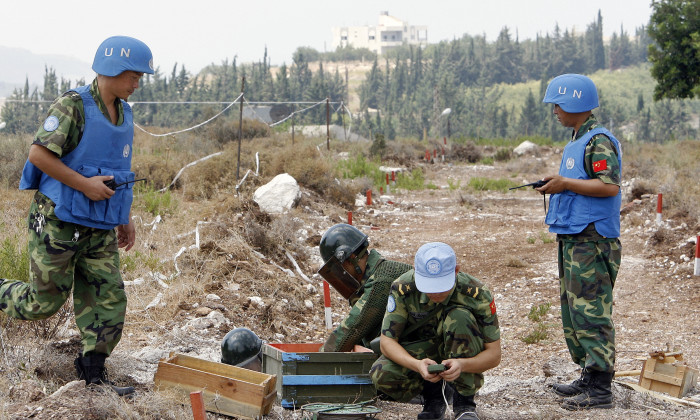
Clearance of landmines refers to the marking and removal of landmines and explosive remnants of war, such as in South Sudan (UNMISS). These activities can be a confidence building measure, such as in Cyprus (UNFICYP), or facilitate the return of internally displaced people, for example in Abyei (UNISFA), or help secure roads for civilian and humanitarian use (UNMISS). UNMAS also works on local capacity building for example in Somalia, where they helped train local police in the area of bomb disposal or in the Central African Republic (CAR) where they are building the capacity of the National Security and Defence Forces and establishing a National Mine Action Authority.
Educational measures aim at increasing public awareness of the dangers of mines. In many peace operations such as in Abyei (UNISFA), CAR (MINUSCA) or in the OSCE Programme Office in Dushanbe, mine awareness training of peacekeepers and civilian staff is also part of UNMAS’ responsibilities.
In the UN context, the UN Mine Action Service (UNMAS) implements appropriate measures, the EU and the OSCE also support projects. Examples:
- MINURSO (Western Sahara)
- UNMISS (South Sudan)
 © Mark Garten
Victim assistance consists of the provision of medical support for victims, strengthening professional qualifications or the reintegration of survivors, but also entails the development of communities such as in Colombia (UNVM).
Stockpile destruction and the management of arms and ammunition include support in the establishment of national standards as well as the storage, transport and inspection of weaponry, such as for CAR state-owned weapons. An additional aspect is capacity building, as the UN did for the Libyan Air Force, supporting its efforts to deal with dangerous chemicals, or the Congolese police in the correct storage of their weapons. These tasks are increasingly part of UNMAS’ responsibility, and are also part of the OSCE portfolios in Bosnia and Herzegovina, Dushanbe and Ashgabat.
The EU finances and supports projects focused on mine victims, development of relevant technologies and capacities, as well as on the clearance of landmines, with a major focus on Ukraine.
As of 05.01.2026