UN General Assembly: Germany's Responsibility for Sustainable Multilateralism
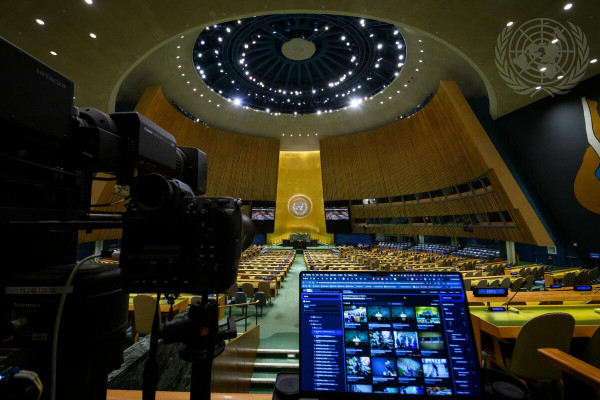 © UN Photo /Loey Felipe, Eskinder Debebe
At the 81st UN General Assembly, the German government underscored its commitment to the United Nations and called for targeted reforms to strengthen multilateralism. Political capacity to act is also essential for effective UN peace operations. ZIF actively supports the work of the UN with 28 currently seconded experts.
At the 81st General Assembly of the United Nations in New York, the future of the multilateral order was at the center of the debate. Against the backdrop of ongoing crises and geopolitical shifts, the Federal Government reaffirmed Germany's clear commitment to the United Nations. Foreign Minister Wadephul, however, couples this engagement with an explicit call for targeted reforms to keep the UN crisis-resilient and capable of taking action.
Germany as the Second-Largest UN Contributor
As the second-largest contributor to the entire UN system and a reliable partner, Germany assumes global responsibility for crisis prevention and conflict management. From supporting diplomatic mediation initiatives to providing qualified personnel for peace operations, the Federal Government actively works to ensure that the international community does not merely manage crises, but shapes sustainable solutions.
Need for Reform: Strengthening Action and Legitimacy
In his address to the United Nations, Federal Foreign Minister Johann Wadephul emphasized that a stable international order requires a strong United Nations. A central key to achieving this lies in adapting UN structures to the realities of the 21st century:
- Modernizing the Security Council: Expanding the UN Security Council is essential to securing the body's legitimacy and representativeness. In particular, underrepresented regions such as Africa, Asia-Pacific, and Latin America must be adequately represented in the future.
- Accelerating Processes: Instead of blockades, the UN needs effective, text-based negotiation formats to react flexibly and decisively to global threats.
- Advancing AI Regulation: To address emerging global risks, Germany is calling for common international safety standards and a UN framework for the responsible use of Artificial Intelligence. Technological progress must always serve human dignity.
Political Capacity to Act as the Key to UN Peacekeeping
Political capacity to act and a clear willingness to reform at the highest level are also the decisive foundation for the work of UN peace operations. How the further development of multilateral missions can succeed and what opportunities the current UN Review offers was recently highlighted by ZIF in a detailed analysis: In the latest ZIF kompakt, Dr. Annika Hansen and Alischa Kugel examine where Germany can assume responsibility and practically drive reforms for crisis-resilient peace operations.
Read more: ZIF kompakt: Gelingt ein „Neuanfang“ für UN-Friedenseinsätze? (German only)
ZIF Personnel on UN Missions
A strong UN thrives on the concrete actions of its member states. On behalf of the Federal Foreign Office, ZIF supports the crucial work of the United Nations with personnel directly on the ground: ZIF has currently seconded 15 experts to UN organizations and an additional 13 personnel to UN humanitarian actors. In doing so, Germany strengthens civilian crisis prevention, peacebuilding, and humanitarian assistance worldwide.