Children and Armed Conflict (CAAC)
The UN Security Council first officially condemned attacks on children in conflict situations in 1999. In 2001, it asked the Secretary-General to report on armed groups that recruit children in violation of international commitments. Since 2005, the Monitoring and Reporting Mechanism (MRM) has been capturing these violations in the following categories:
More than one billion children and adolescents are affected by armed conflict, according to estimates by the United Nations Children's Fund (UNICEF). The protection of children has, for example, been part of the mandate of:
- MINUSCA (Central African Republic)
 © Hosien Azour/Unsplash
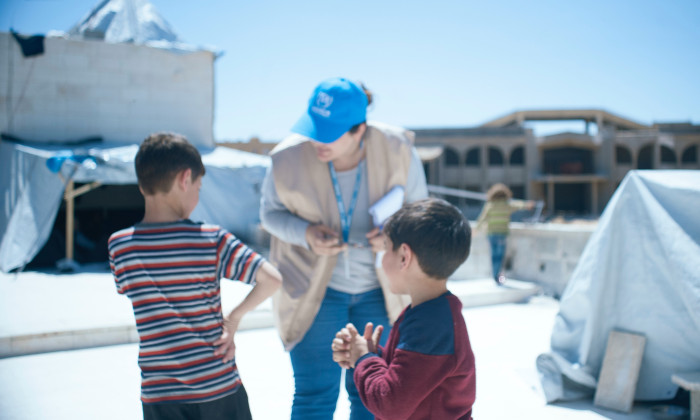
Child protection has been a mandated task of UN peace operations since 2001 and will be implemented in nine missions in 2020. Although child protection is a cross-cutting task that touches on the efforts of various mission components, such as >Human Rights, >Rule of Law and >Disarmament, Demobilization and Reintegration, as well as on those of the police and military components, missions have also deployed dedicated Child Protection Advisers since 2007. Their remit is to integrate the needs and concerns of children into the political agenda and operational strategy of the mission and, to this end, to coordinate available resources, to sensitize mission personnel to this topic and to document crimes against children. UNICEF is a critical partner for peace operations in its work on child protection.
According to the United Nations, over the past 25 years, their work has resulted in nearly 170,000 children being removed from armed groups, and 13 resolutions on children in armed conflict being passed by the Security Council.
The OSCE had tasked its former mission in Ukraine (SMM) with monitoring the situation of children. Its presence in Moldova supports the fight against the sexual exploitation of children. The needs of children have also been embedded within the broader context of human rights work in EU CSDP missions. EU heads of mission have been tasked with paying particular attention to the impact of conflict on children and integrating their needs into the work of a mission.
As of 23.02.2026