Countering Organized Crime
Transnational Organized Crime has been recognized as a major driver of instability and conflict. This directly impacts peace operations. In a context of increased violence, destabilized economies and eroded governance, peacekeeping becomes increasingly difficult. Attention to this threat has increased in recent years, and the engagement of peace operations in countering organized crime continues to evolve. Several missions, even when not explicitly mandated to counter organized crime, have developed technical activities and programmes and integrated these efforts into other mandated tasks e.g. in the areas of > Policing, > Rule of Law or > Protection of Civilians.
Before its withdrawal in 2023, the UN mission in Mali (MINUSMA) was mandated to provide technical support to Malian judicial institutions in their efforts to investigate and prosecute individuals suspected of organized crime activities including trafficking in persons, arms, drugs and natural resources as well as migrant smuggling and terrorist financing. MONUSCO in the Democratic Republic of the Congo and MINUSCA in the Central African Republic assist the government in tackling trade in illegal resources, which primarily benefits armed groups. Similarly, several UN special political missions have carried out measures to counter organized crime, particularly through regional offices in Central and West Africa, UNOCA and UNOWAS aim to strengthen local capacities for countering transnational threats including drug trafficking and other forms of organized crime. Alongside peace operations, such as in CAR, Yemen, Somalia or South Sudan, UN sanctions regimes also target individuals and entities to curb arms trafficking and support conflict resolution, peacebuilding and human rights
Organized crime can undermine the objectives and mandate implementation of a peacekeeping mission in a variety of ways. Examples of missions conducting OC countermeasures:
- MONUSCO (Democratic Republic of the Congo).
- EUBAM Libya
- OSCE Mission to Bosnia and Herzegovina
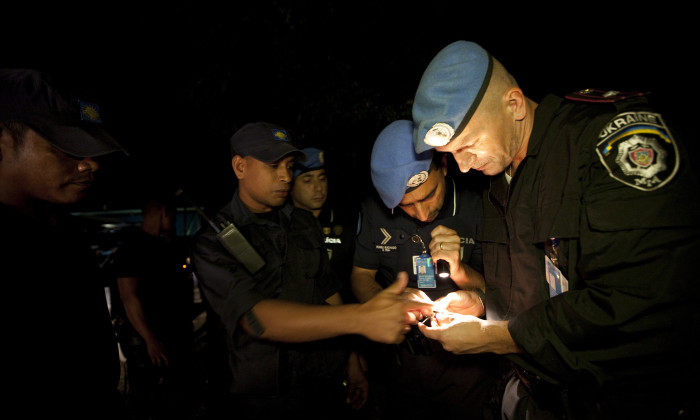 © Martine Perret
Through its presences in Bosnia and Herzegovina and Montenegro, the OSCE supports national actors in fighting human trafficking, corruption and other organized crime, including by building the capacity of judges and prosecutors. Another central element is strengthening legal frameworks for the criminal prosecution of traffickers and harmonizing national laws with international standards.
Some EU missions have explicit mandates to counter threats arising from organized crime. EUNAVFOR MED IRINI contributes to implementing the arms embargo imposed by the UN Security Council (> Maritime Security), and to disrupting the business model of human smuggling and trafficking networks in the Mediterranean. EULEX Kosovo fosters international police cooperation, EUAM Ukraine considers organized crime in the context of security sector reform and anti-corruption support, and EUBAM Libya builds Libyan capacity to fight terrorism and cross-border crime.
As of: 05.01.2026