European seconding agencies call for strengthened guidance on Youth, Peace and Security in civilian CSDP missions
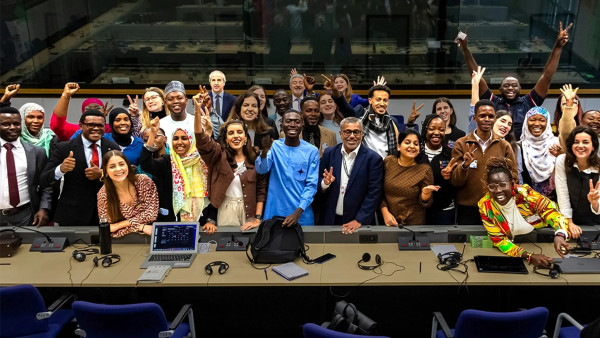 EU Youth, Peace and Security Conference and YPS Week in Brussels, November 2025 | © Anthony Fedorov
Civilian Common Security and Defence Policy (CSDP) missions are increasingly engaging young people in their work, but the Youth, Peace and Security (YPS) agenda is not yet consistently integrated into mission planning, reporting and evaluation. Following joint expert discussions in 2025, three European seconding agencies highlight the need for clearer operational guidance to support missions in turning policy commitments into practice.
The discussions were convened by the Folke Bernadotte Academy (FBA), CMC Finland and the Center for International Peace Operations (ZIF)during the tenth anniversary year of UN Security Council Resolution 2250 on YPS. They brought together experts and practitioners to examine how youth perspectives can be better reflected in civilian CSDP missions and part of the mandate implementation.
In many contexts where civilian CSDP missions operate, including Kosovo, Mali and the Central African Republic, young people make up a significant share of the population. Many are active in local initiatives that support peacebuilding, community security and dialogue, while often remaining underrepresented in formal decision-making.
A key conclusion from the discussions was that important progress has been made, but implementation remains uneven. Several missions have developed promising practices, including youth consultations, outreach activities, youth-sensitive analysis, community engagement mechanisms and internal coordination structures linked to the mission’s mandate delivery. However, these efforts often depend on individual initiatives rather than systematic operational approaches.
– The issue is not whether young people are relevant to peace and security, but whether missions have the tools to include their perspectives systematically in analysis, planning, delivery and reporting, said Per Olsson Fridh, Director General at FBA.
From policy commitments to operational practice
The 2023 Civilian CSDP Compact gave new momentum to the YPS agenda by committing civilian CSDP missions to promote YPS and by tasking the European External Action Service (EEAS) with implementing the 2022 EU Youth Action Plan in EU external action. A dedicated 2024 mini-concept has since provided practical entry points for missions, including mainstreaming youth perspectives, supporting host States’ YPS action plans and frameworks, strengthening capacity through training and advisory support, and developing more youth-sensitive monitoring approaches.
– The policy framework is increasingly in place. The next step is to make YPS usable in day-to-day mission planning, advisory work and monitoring, and then being reported on as part of the mission implementation said Director Timo Hämäläinen at CMC Finland.
Promising practices across missions
Examples from mission settings show how YPS can be translated into practice. EUCAP Sahel Mali, for example, has worked with young security trainees and supported local security committees where youth organisations contribute with perspectives on local security concerns.
Other missions have strengthened youth consultations, youth-sensitive analysis, community engagement mechanisms and internal coordination across mandate areas. In EULEX Kosovo, for example, a youth focal point network has helped to strengthen coordination of youth-related activities across the mandate areas.
These approaches can improve missions’ understanding of local security dynamics, strengthen trust with communities and make activities that support security service delivery more responsive to the realities of the societies in which civilian CSDP missions operate.
Making YPS more systematic
The expert discussions also pointed to a need for more standardised operational guidance. Participants highlighted the value of integrating YPS more clearly into operational planning, including through standard language in Operational Plan (OPLAN) templates and relevant planning documents, for example alongside human rights and gender equality considerations. Stronger links to reporting and evaluation would also help missions treat youth perspectives as a cross-cutting issue rather than as a separate activity. Furthermore, making the youth perspective a clearer part of the analysis would strengthen the overall situational awareness.
For FBA, CMC Finland and ZIF, this is also a practical priority. As seconding agencies, the three organisations support civilian crisis management through recruitment, training, expertise and secondments. personnel already have access to YPS training as part of preparation for civilian crisis management, and the agencies continue to maintain capacity for specialised training, expert exchange and coordination between YPS focal points. FBA and ZIF have also seconded YPS experts to other international organisations, including the UN, the OSCE and the Council of Europe.
– Seconding agencies have an important role to play in strengthening the expertise that missions can draw on. Through training, recruitment and continued exchange between practitioners, we can help make YPS more visible and more practical in civilian crisis management, said ZIF’s Executive Director, Dr. Astrid Irrgang.
By sharing lessons from the 2025 discussions, FBA, CMC Finland and ZIF aim to support continued efforts to make YPS a more systematic part of civilian CSDP and to contribute to its further development as a key instrument of EU crisis management.