ZIF at the German Bundestag: Discussions on Peacekeeping Missions, EU Security Policy, and Armenia
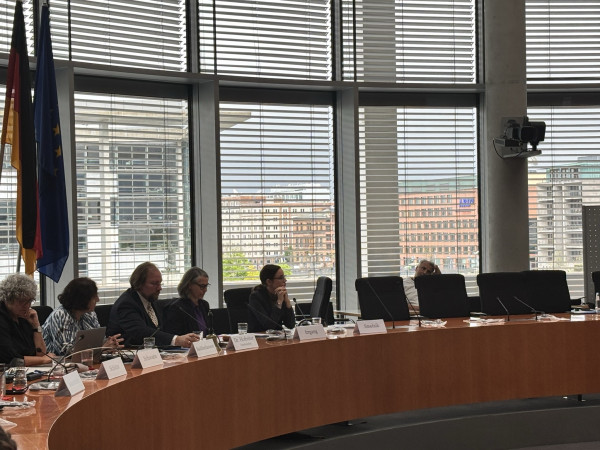 ZIF-Chefin Dr. Astrid Irrgang zur Anhörung im EU-Ausschuss des Bundestages
Discussion with the SPD parliamentary group: Focus on civilian expertise
At the invitation of foreign policy spokesperson Adis Ahmetović, Dr. Irrgang participated in a discussion with the Deputy Director of ZIF in the SPD parliamentary group’s Foreign Affairs Working Group.
The discussion centered on ZIF’s mandate on behalf of the German government and current challenges facing international peace missions. Particular attention was paid to the growing impact of hybrid and cyber threats on mission contexts worldwide, as well as ZIF’s contributions in this area through seconded staff.
Integration of civilian and military instruments
In a discussion with Dr. David Preisendanz (CDU), a member of the Bundestag and the EU Committee, the focus was on the ZIF’s role as a partner to the Bundestag and on civilian expertise in EU contexts.
A key shared understanding: Military capabilities and civilian crisis prevention are complementary and must be strengthened together. The importance of broader public communication regarding this interplay was also emphasized.
EU Committee: Situation in Armenia and the contribution of the EU Mission EUMA
During a hearing of the EU Committee on the situation in Armenia, Dr. Irrgang outlined the ZIF’s contribution to the EU Mission EUMA and other secondments in the context of Armenia.
Dr. Astrid Irrgang, together with Ambassador Satu Koivu (EUMA) and Franziska Smolnik (SWP), assessed the security situation. The hearing took place at the invitation of Committee Chair Dr. Anton Hofreiter.
It became clear that while the peace process between Armenia and Azerbaijan has made progress in recent years, it remains fragile. The EU Mission (EUMA) continues to make an important contribution to stabilization on the ground.
Dr. Astrid Irrgang emphasized: “Developments in Armenia show how important long-term European engagement remains. Peace processes are not linear—they require continuous support, even beyond traditional mission mandates.”
Outlook: Thinking about European security together
Civilian expertise will continue to play a central role in European peace and security policy – particularly when dealing with hybrid threats and during transitional phases in conflict-affected regions. The constructive dialogue within the German Bundestag underscores the importance of close cooperation between politicians, academics and experts in the field.