Workshop in New York: International partners discuss the future of coalitions and peace operations
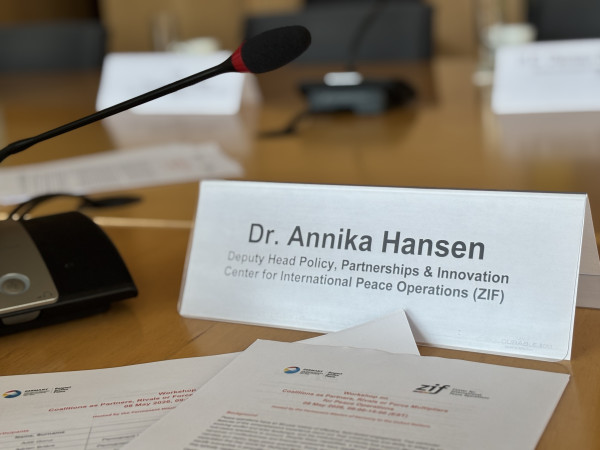
What role will international coalitions play in future crisis response and peace operations? And how can they meaningfully interact with UN-led missions, EU operations or African peace operations? These questions were at the centre of a high-level workshop organised by the Center for International Peace Operations (ZIF), together with the Permanent Mission of Germany to the United Nations, on 8 May 2026 in New York.
Under the title “Coalitions as Partners, Rivals or Force Multipliers for Peace Operations”, around 80 participants from UN member states, the United Nations, the African Union, the European Union, think tanks, and practitioners from ongoing missions came together. The aim of the workshop was to analyse the opportunities and risks of coalitions in international crisis response and to discuss approaches for more coherent international engagement.
Coalitions between pragmatism and political reality
Against the backdrop of growing geopolitical tensions and increasing reluctance in the Security Council to mandate large-scale peace operations, coalitions are gaining international relevance. Many states see them as a way to achieve faster, more flexible and more cost-effective deployments. At the same time, the workshop made clear that coalitions also come with significant challenges, particularly in terms of legitimacy, accountability and long-term political impact.
Participants discussed experiences from Haiti, Somalia, the Sahel and Timor-Leste, among others. A key takeaway was that short-term military stabilisation must not come at the expense of sustainable political solutions.
“Coalitions can make important contributions – especially in situations where rapid action is required. However, it is essential that they are embedded in an overarching political strategy and strengthen, rather than weaken, existing multilateral structures,” says Dr Annika Hansen, Deputy Head of Policy, Partnerships and Innovation at ZIF, who moderated the workshop.
Peace operations remain indispensable
A central conclusion of the discussions was that UN, AU and EU peace operations continue to offer key comparative advantages – including institutional knowledge, established accountability mechanisms, long-term presence, and the ability to integrate political and civilian approaches.
Participants emphasised that partnerships and strategic coherence will become even more important in the future. Rather than competition between different formats, greater coordination of international actors and their respective strengths is needed.
The workshop thus contributed to ongoing debates on the future of multilateral peace operations and highlighted the importance of innovative partnerships in an increasingly complex security environment.