New Partnerships, strategic communication, future orientation: ZIF's International Advisory Board Annual Meeting
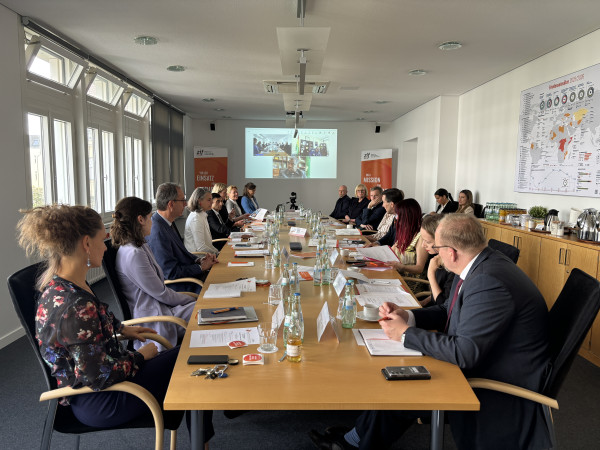 Sitzung des Internationalen Beirats des ZIF 2026 / Foto: ZIF
On June 10 and 11, 2026, the annual meeting of the ZIF’s International Advisory Board took place. The board comprises senior officials and representatives from international organizations, the German Armed Forces, and research and training institutes in the field of peacekeeping, as well as seconded staff.
“Restoring Faith in the Multilateral System”
was the central theme of the annual meeting, which, in addition to a formal opening session, consisted of several workshops on topics such as the innovative potential of AI for peacekeeping missions. The cultural program focused, among other things, on creative approaches to addressing the requirements and needs of target groups and the associated agility and willingness to experiment—even in management—and took place at the pioneering Galerie König in Kreuzberg.
Almut Möller, Director of European and Global Affairs and Head of the Europe in the World Program at the European Policy Centre (EPC), shared her perspective on European engagement in international politics during a dinner speech.
New Partnerships, Strategic Communication, Sustainability
In an era of growing disengagement from international organizations, new—and in some cases temporary—partnerships and alliances are becoming increasingly important. The Advisory Board sees this as a new area of consultation for the ZIF as well, so that existing approaches can be integrated while simultaneously being developed in innovative ways.
“The current world order is characterized by uncertainty and fragmentation, with an increasing number of crises arising across numerous interconnected issue areas. To ensure effective crisis management in this world, we must make bold decisions and take actions that go beyond our comfort zone,” said Dr. Astrid Irrgang, Executive Director of the ZIF.
The panel identified strategic communication as one of the indispensable core competencies of organizations and missions—to counter disinformation and help shape narratives in the face of budget cuts.
All participants viewed budget cuts—particularly in the areas of conflict management, humanitarian aid, and international organizations—as the greatest challenge, as they directly impact operational readiness. This requires complex prioritization and focus to maintain the effectiveness of the tools—ideally in close coordination with national partners and within an international network. When used responsibly and purposefully, technology can strengthen peacekeeping—for example, in data analysis and processing, early warning, and scaling up activities.
Key partner organizations represented on the advisory board
Participants included, among others, the highest-ranking UN police officer, UN Police Advisor Faisal Shakar; Stefano Tomat; the EU’s Civilian Operations Commander, Dr. Benedetta Berti; the Secretary General of the NATO Parliamentary Assembly; and Air Commodore David Anetey Akrong, Commander of the Kofi Annan International Peacekeeping Training Centre (KAIPTC) in Ghana.
“The exchange of ideas in this highly experienced and high-caliber group, transcending all organizational and institutional boundaries, is of inestimable value to us at ZIF—and to all members—in these times. After all, only by learning together can we move forward,” concludes Irrgang.