ZIF discusses challenges in 2026 in the Bundestag
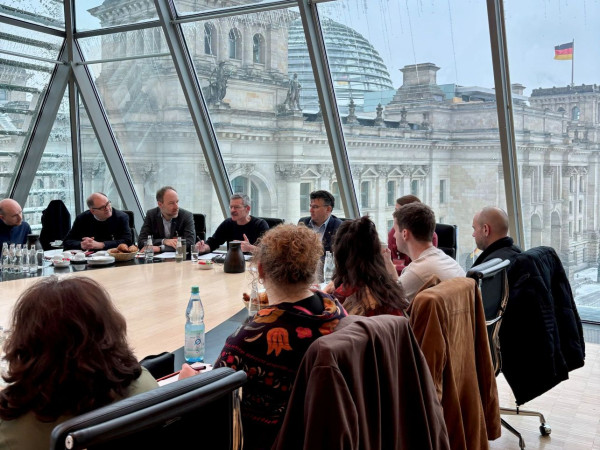
What crises and conflicts will shape international politics in 2026? ZIF addressed this question at the event ‘Headlines Before They Happen’ in the German Bundestag. Together with several members of the Bundestag and around 40 staff members from MPs' offices and parliamentary groups, ZIF experts discussed international developments and their significance for German foreign and security policy.
The event focused on an outlook for acute, probable and possible crises in 2026 based on a systematic evaluation of international forecasts (including those from the International Crisis Group, the European Council on Foreign Relations, the Eurasia Group and The Economist) by ZIF analyst Tobias von Gienanth. The format has been offered by ZIF for several years as a ‘Review of Forecasts’ and took place once again at the invitation of ZIF Supervisory Board member Boris Mijatovic, Member of the German Parliament, and ZIF Executive Director Dr. Astrid Irrgang.
Disorder and uncertainty
The international order is increasingly characterised by uncertainty and fragmentation. The Middle East, Sudan, Ukraine, Ethiopia, Eritrea, Myanmar and Haiti were named as particularly relevant trouble spots for 2026. The number of armed conflicts worldwide is higher than at any time since the Second World War. In addition, around 120 million people worldwide are fleeing their homes.
According to the latest report on social inequality by the aid organisation Oxfam, inequality is also continuing to rise. Currently, the 12 richest people in the world already own more wealth than the poorer half of the world's population, which corresponds to over 4 billion people.
ZIF experts Tobias von Gienanth, Tobias Pietz, and Andreas Wittkowsky made it clear that civilian approaches to peacekeeping are more necessary than ever in light of growing global uncertainty and that civilian crisis management must be further strengthened.